Pile weatherstrip specifications
Twenty-four standard backing widths, the U.S. nominal each one sits against, tolerance, roll length and lead times. Non-standard widths are quoted, not refused.
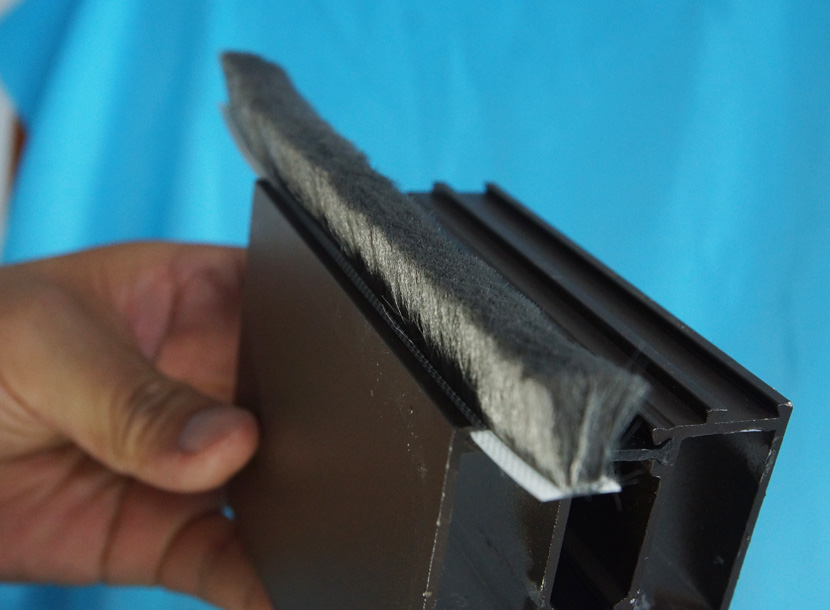
| The nominal you run | Equals | Route · sample lead time | Existing die sits at |
|---|---|---|---|
| 1/4″ · .250 | 6.35 mm | On tooling · 15 days | 6.4 mm · 0.05 over |
| .430″ | 10.92 mm | On tooling · 15 days | 11.0 mm · 0.08 over |
| .270″ | 6.86 mm | On tooling · 15 days, try it first | 7.0 mm · 0.14 over |
| 3/16″ · .187 | 4.76 mm | Die cut for you · 30 days | 4.5 mm · 0.26 under |
| 1/2″ · .500 | 12.70 mm | Already running | 12.55–12.8 mm, splice-free |
On 3/16″ our 5.0 mm is fractionally closer in absolute terms (0.24 over), but the table lists 4.5 mm because an undersize backing still enters the slot and an oversize one may not. Ask for both and try them side by side before anyone cuts anything.
The twenty-four widths already on tooling
A width that is not on this list is not refused — we cut a die for it and carry the cost. What the list buys you is time: these ship in fifteen days, a new profile in thirty. The routing table above shows how a U.S. nominal lands against the ones we already have.
- 4.157″
- 4.5.177″
- 4.7.185″
- 5.197″
- 5.4.213″
- 6.236″
- 6.2.244″
- 6.4.252″
- 7.276″
- 7.5.295″
- 8.315″
- 8.4.331″
- 9.354″
- 9.5.374″
- 10.394″
- 11.433″
- 11.5.453″
- 12.5.492″
- 12.8.504″
- 13.7.539″
- 15.591″
- 19.5.768″
- 25.984″
- 401.575″
Millimetres are the manufactured dimension; the inch figure is the conversion, not a separate size. Tolerance on every one of them is ±0.15 mm.
A die is not a wall
Any backing width you run, we make. The only thing that changes is how long it takes. Twenty-four widths are on tooling today and sample in fifteen days. Anything else, we cut a die for it — fifteen days more. Pile height, fin, colour and roll length are specified the same way on either route.
The die is at our cost, not yours. Nothing to pay up front, nothing to earn back against an order, and it stays reserved to your part number. That is the normal route here, not a favour: most of what leaves the plant runs on tooling cut for one customer.
Where an existing die lands near a U.S. nominal rather than exactly on it, the table above prints the gap rather than rounding it away — our standard widths are manufactured in millimetres, and you would find the difference on the first assembly regardless. A gap you can live with saves you fifteen days; a gap you cannot is what the dedicated die is for.
1/2″ is confirmed and already running — splice-free, cut to your roll length. Ask for a sample and we will quote against it.
| Attribute | Range |
|---|---|
| Pile height | from 2.5 mm (0.098″) upward |
| Pile material | Polypropylene |
| Centre fin | Available |
| Silicone treatment | Available |
| Pile-to-backing bond | Heat-fused, polypropylene to polypropylene — no adhesive in the bond |
| UV stabilisation | Available on request — dosed to the filament, base yarns and backing film |
| Colours | Multiple standard; custom on request |
| Attribute | Value |
|---|---|
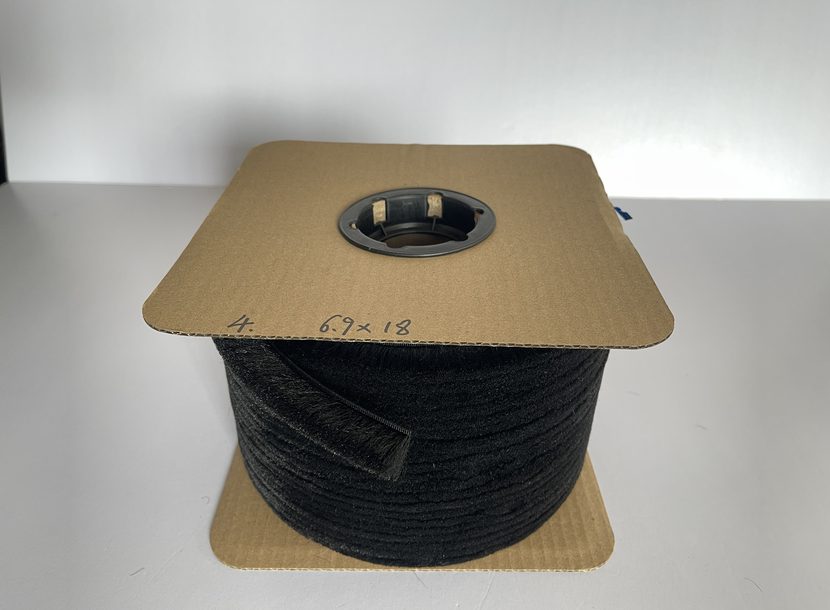
| Standard spool length | Made to your put-up — tell us the run length |
| Maximum splice-free run | 300–1,000 ft (91–305 m) is routine; longer runs quoted |
| Dimensional tolerance | ±0.15 mm |
| Minimum order quantity | Scales with price — small runs welcome, quoted per volume |
| Sample lead time | 15 days on existing tooling; 30 days if a new backing profile has to be cut |
| Production lead time | 15 days ex-works on a first order, from receipt of deposit. U.S. contract volumes have run 30–45 days. Add 10 days if the filament colour has to be spun to order. |
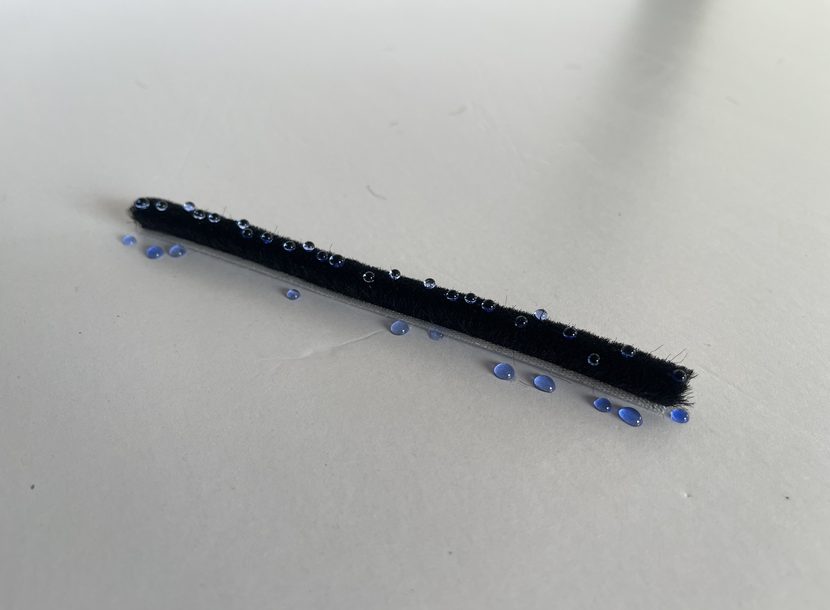
Wool pile is the trade name for this whole category; on our lines the filament is polypropylene, not wool. Kerf pile is the same product, named after the slot it seats in. Diamond base and square base describe the small solid backings on our cross-base and square-base lines rather than a flat one. The name on your drawing does not change what we cut — send us the section.
Preliminary spec sheet
One page: every figure published above, the section drawing, and the imperial conversion table. Fields still being confirmed with the plant are marked as such rather than filled in with a guess.
Tell us the sizes you run
Or post us 50 mm of your extrusion and we will cut a sample to it. Samples and any tooling are on us — freight collect on your courier account. No call required.